Early backend lessons from building a task management app with Django
22 de febrero de 2025
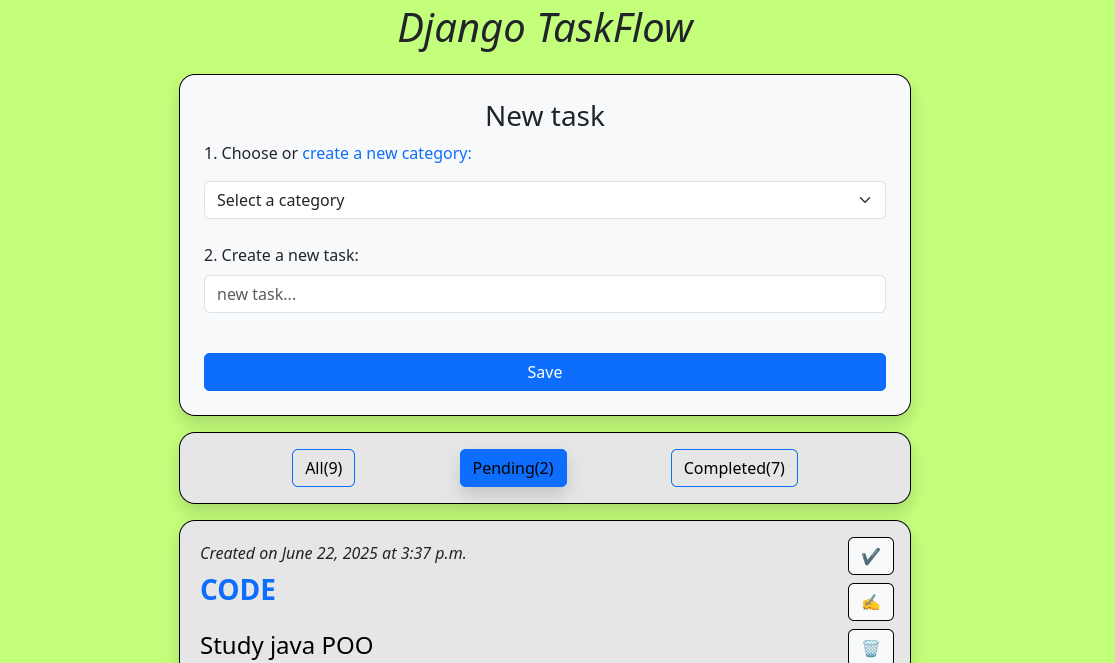
This project represents an early but significant stage in my backend development path.
With Django TaskFlow, my objective was to move beyond isolated scripts and start thinking in terms of complete backend applications: data modeling, business logic, persistence, and structure.
Rather than focusing on advanced scalability concerns, the priority was understanding how the different parts of a backend system fit together and how design decisions affect maintainability over time.
What the project does
Django TaskFlow is a task management application that allows users to create and organize tasks using customizable categories.
The project includes:
- CRUD operations for tasks
- category-based organization
- persistent storage using a relational database
- a simple, function-first user interface
The emphasis was on backend behavior and data flow rather than frontend polish.
Why Django was a good fit for this stage
Django’s batteries-included philosophy made it particularly suitable at this point.
Its ORM, migrations, authentication system, and admin panel allowed me to experiment quickly while enforcing consistent patterns. This helped me focus on backend fundamentals without being distracted by excessive setup or tooling decisions.
More importantly, Django encouraged thinking in terms of conventions and structure, which proved valuable as projects grew in complexity.
Backend principles reinforced by this project
Working on this application helped consolidate several important backend concepts:
- modeling data and relationships in a relational database
- separating business logic from presentation concerns
- understanding the long-term impact of architectural consistency
- recognizing how small design decisions affect maintainability
Like many early projects, it exposed design limitations and tight coupling, which later became reference points for improving future architectures.
How I would approach it today
With more experience, there are several aspects I would handle differently:
- a clearer separation between API logic and presentation
- an API-first design mindset
- stronger typing and validation at system boundaries
- more modular and testable components
These considerations now guide how I design backend systems, regardless of framework.
How this project influenced my backend direction
Django TaskFlow played an important role in shaping my backend perspective.
It clarified what I value in backend frameworks: clarity, explicit structure, and long-term maintainability. Those principles later guided my move toward API-oriented frameworks such as FastAPI, and eventually toward NestJS.
While the project itself is simple, its impact lies in how it influenced my approach to backend development rather than in its feature set.