Exploring Blog Automation: An Architecture with Astro and Airtable
28 de abril de 2026
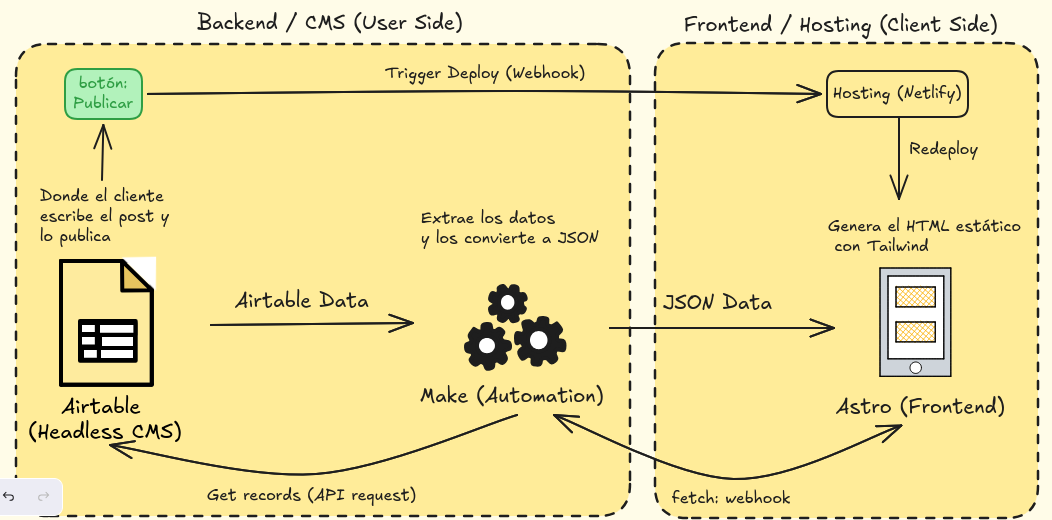
When planning a personal blog, developers often choose between the convenience of a traditional CMS and the lightweight nature of Markdown files. In this small project, I wanted to explore a middle ground: a system that allows for frictionless writing without sacrificing the simplicity of a static site.
The Proposed Workflow
My goal was to create a straightforward cycle that separates content management from infrastructure. The architecture relies on three basic components:
- Data Management (Airtable): Using a simple, structured grid to organize posts visually.
- The Connector (Make.com): A small scenario that detects updates and triggers a rebuild of the site.
- Generation (Astro): A modern framework that fetches data and converts it into pure HTML during the build process.
Performance Observations
During development, I noticed that using Tailwind via CDN, while helpful for quick prototyping, was adding unnecessary overhead to the initial page load.
By migrating to a Native Tailwind v4 integration and leveraging Astro’s static nature, the site’s performance improved significantly. Beyond seeking high audit scores, the exercise was about understanding how browsers process styles more efficiently when CSS is optimized at build time.
Technical Aspects I Tried to Address:
- CSS Footprint: Generating only the necessary styles for each page.
- Basic Accessibility: Reviewing contrasts and semantic tags for a more navigable experience.
- Static Site Generation (SSG): Removing active database connections at runtime to simplify security and speed.
Takeaways
This exercise reinforced the value of system integration. Sometimes, the solution isn’t writing more code, but connecting the right tools in a logical way.
It was also a good opportunity to get familiar with the new Astro Content Layer API, specifically regarding asynchronous data fetching from external sources without compromising the final user experience.
Future Considerations
This system is currently a proof of concept with room for improvement. Moving forward, I would like to look into:
- Automated image optimization to further reduce page weight.
- A smoother preview workflow for drafts.
- Incremental regeneration strategies for larger content volumes.
Project Links
- Live Demo: View Site
- Repository: GitHub Source